
About the Client
Trustpool is a cryptocurrency mining pool that ranks among the world's top 10 for mining Bitcoin and other cryptocurrencies.
The Challenge
Identify the best platforms and messaging to attract new customers at the lowest possible cost.

The Market Had Changed, and We Needed to Understand It All Over Again
Trustpool is a cryptocurrency mining pool. I was responsible for its marketing, but much of what our team did was based on guesswork, indirect data, and the few metrics we could actually track. This approach came at a cost: we constantly had to come up with shaky hypotheses and spend money testing them.
The market had changed, and we needed to find new solutions. Bitcoin went through its halving in April, making the market particularly unstable. Mining was no longer profitable for many users, so they started switching off their machines.
The audience was changing too. Mining was gradually evolving from a hobby for tech-savvy DIY enthusiasts into a serious business. Small mining setups in home garages were giving way to large industrial mining facilities. This was a completely new type of customer, and we still had to figure out how to reach and work with them.
Home Miner | Industrial Miner |
|---|---|
2–4 ASIC miners with a total hashrate of 300–600 TH/s | 40+ ASIC miners with a total hashrate of 6,000+ TH/s |
An individual mining in a garage, vacation home, or private house | A registered company operating a dedicated mining facility with engineers and security staff |
To move forward, we needed to get a clear picture of who our customers really were, how they chose a mining pool, and why they stayed with us. We already had some assumptions about our audience, but I wanted to test them by talking to actual customers.
I also hoped to find new content ideas: figure out what miners read, what they were interested in, and what kind of content might catch their attention. As it turned out, I was in for a bit of a professional disappointment.
We set four specific goals for the research:
Find out what our potential customers read and watch. We wanted to build a list of sources they used to get information, both in general and about mining specifically. We could then use these platforms for advertising.
Understand what kind of content our potential customers consume. We wanted to come up with specific content ideas that would appeal to our audience and encourage them to work with us.
Understand how customers make decisions. We wanted to identify the needs and goals behind their choices. For example, someone might choose our pool because they want reliable technical support, while their bigger goal is to generate passive income. These are the motivations we could use in our content and messaging.
Find out what they value in services in general and mining pools in particular. This was the most exciting part: figuring out which factors mattered most to our customers. We wanted to understand why they chose us over other pools. Their answers could become ready-made headlines for our website, ads, and articles.
Outsourcing the Research Was Too Expensive
I'd never conducted customer discovery interviews before, so my first thought was to outsource the research. Luckily, I knew quite a few people who worked in this field. I reached out to them for recommendations, asked for contacts of experienced researchers, and posted a request in a research professionals' chat.
But after talking to around a dozen researchers and having calls with several of them, my enthusiasm quickly faded. The quotes ranged from 800,000 (about $8,300 in Oct 2024) to 1,950,000 (about $20,300 in Oct 2024) rubles — way too expensive for our situation. The crypto market is still young and changes incredibly fast. That meant we'd need to update the research fairly soon. Spending that much money on a regular basis, without knowing whether it would pay off, didn't seem like a great idea.
So we hired a consultant and decided to conduct the research ourselves. This way, we could kill two birds with one stone: get the research done and teach our team how to run similar studies in the future. Together with the expert, we figured out whom to interview and what questions to ask. Throughout the project, we had regular calls to discuss the interviews and our findings. He helped us navigate the parts of the process we had no experience with.
Outsourcing the research | Consulting + doing it ourselves |
|---|---|
800,000–1,950,000 RUB ($8,300 – $20,300) | 58,490 RUB ($609) |
✅ Conducted by professionals | ✅ Guidance from an experienced researcher ✅ We can use our existing customer database ❌ Requires time and resources from our team ❌ Demanding, labor-intensive work |
Designed the Research and Recruited Participants
During our first call with the research consultant, we defined clear research goals that would allow us to measure the results. We also decided who we wanted to interview and put together a rough list of questions for participants.
We decided to focus on customers who had been using Trustpool for a long time and were already generating revenue for us. Mining pools earn money through fees on mining rewards, so a customer's hashrate directly affects our revenue. For the interviews, we selected individual miners with above-average hashrates who had been using our pool for at least a year. We wanted to talk to people who had already chosen Trustpool and continued to use our service.
We put together a short questionnaire with as few questions as possible. A long form could scare potential participants away, so we kept it to just two fields:
Account name or email — to check how long they'd been with us and their hashrate;
Contact details — to arrange an interview.
We sent the questionnaire to our email list and posted announcements on social media. In total, around 10,000 users received the invitation. Still, we weren't expecting a huge response. Miners tend to be very private and value their anonymity, so we knew there was a chance that no one would want to talk to us. Luckily, enough people signed up for us to move forward.
Read the invitation | Responded | Met one criterion | Met both criteria | Completed the interview |
|---|---|---|---|---|
11,350 | 111 (0,98%) | 47 (0,41%) | 24 (0,21%) | 20 (0,18%) |
In many of the research proposals we received, recruiting participants was the biggest expense, even though we already had our own customer database. Now I understood why: out of 11,350 users who read our invitation, only 0.18% actually made it to an interview.
Together with the consultant, we decided what information we needed to collect during the interviews. We came up with 26 questions, divided into four main sections:
Who our customers are. Where they live, what they do for a living, what they're interested in, and how they spend their free time.
Why they got into mining. What was happening in their lives when they started mining, what problem they wanted to solve, and what results they expected.
How they made their decision. What alternatives to mining they considered, how they searched for a pool, which competitors they compared Trustpool with, and what made them hesitate.
What they read and watch. Where they learned about mining, which bloggers they follow, and what media they consume — including topics beyond crypto.
I reached out to all 24 users who met both criteria and arranged interviews with them. During our conversations, four more participants decided to drop out.
Conducted Interviews and Organized the Findings in a Spreadsheet
Each interview lasted about an hour. But first, we had to get people on a call. Some didn't respond, others rescheduled, and I often had to follow up and find a new time that worked for everyone. Organizing the interviews turned out to be a challenge of its own.
Together with the consultant, we prepared three sets of questions for the interviews. I started by asking participants about themselves: where they lived, what they did for a living, what they enjoyed doing, and how they got into mining. I wanted to understand what role mining played in their lives. Was it their main business, a side income, or a way to achieve some other goal?
Next, we explored how each person chose their mining pool. What options did they consider? What factors mattered most? How did they discover Trustpool, and why did they decide to join? I asked them to walk me through the entire process, step by step — from deciding to start mining to choosing a pool.
We also looked for pain points in real stories. If someone mentioned using a workaround to get something done, that was a reason to dig deeper: why did they need those extra steps, and what was stopping them from doing things more easily? We avoided asking directly about problems. Questions like that often push people to come up with issues they don't actually experience.
At the end of each interview, I asked about their media habits: what they read and watched, which websites they visited, and where they got information about mining. We were looking for potential advertising channels and new content ideas.
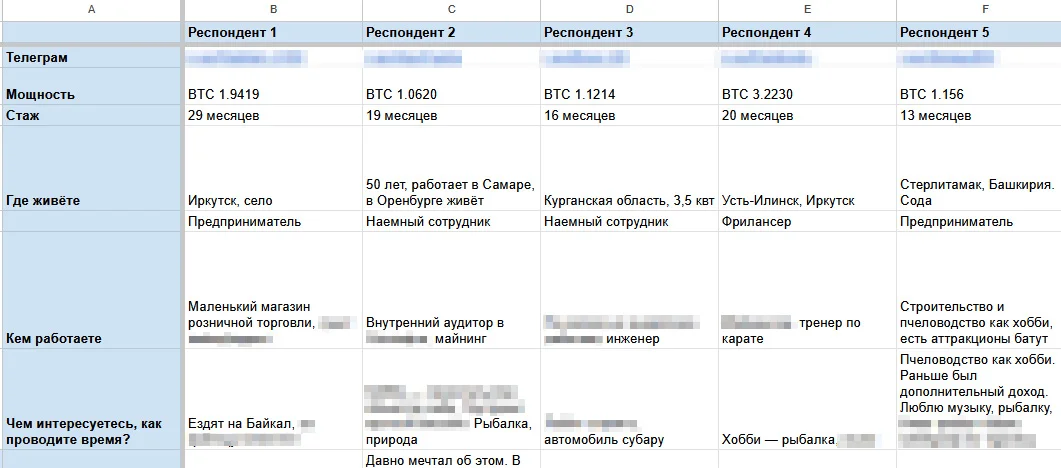
We recorded every interview and then organized the answers in a shared spreadsheet. This allowed us to compare participants' experiences and identify common patterns.
Discovered Unexpected Marketing Opportunities
The most interesting findings came when we explored why people got into mining in the first place. The obvious answer seemed to be making money from cryptocurrency. But for some customers, mining also helped solve problems in their main business.
For example, one participant told me that his furniture factory had replaced the heaters in its drying chamber with mining equipment. According to him, the mining itself was running at a loss, but the heat generated by the machines helped reduce furniture production costs. If you only looked at mining profits, this customer’s setup seemed strange. But when you considered the economics of his entire business, it made perfect sense.
We uncovered a whole range of connections between mining and other industries, helping us understand what could open the door to the B2B market. We learned what challenges these customers faced, which channels they used, and what influenced their decisions.
The research revealed that our marketing approach was wrong. The key benefit we'd been highlighting for years turned out to be largely irrelevant to our customers. We discovered that users actually valued something entirely different, while our unique selling proposition (USP) barely mattered to them.
The research also threw a wrench into my content plans. I'd hoped to discover what kind of content could help us attract bigger customers. But it turned out that the experienced miners we interviewed barely consumed any mining-related content. They'd already figured everything out, set up their equipment, and moved on to running their businesses.
In the end, we identified four customer segments and developed an approach for each one. We started working on the first segment right away. The second required improvements to our existing infrastructure, the third was handed over to management, and the fourth was left for future opportunities.
The research gave us six major initiatives — enough to keep us busy for another year. Each one helped us significantly reduce marketing costs because we finally started speaking our customers' language. Conversion rates increased by an average of 40–60% because we were now highlighting the benefits that actually mattered to customers and knew exactly which audiences to focus on.