
About the Client
TRUST is a crypto ecosystem. It includes products for mining and crypto exchange. Trustpool, the company's mining pool, among the world's top 10 mining pools for Bitcoin and other cryptocurrencies.
The Challenge
To develop a strategy for planning, producing, and distributing content. Then scale content production to attract more new customers and keep existing ones entertained.

For a Long Time, All the Content Rested on One Person’s Shoulders
Like any startup, the company had plenty of talented people wearing multiple hats. One of them was Lesya Bugrimova — a writer, editor, content strategist, PR specialist, and analyst all rolled into one. She was responsible for all the content the company published.
Lesya did an incredible job creating content and distributing it across different platforms. But she simply didn't have enough time to document the production processes. When your entire content team consists of a writer and a designer, you don't really need formal processes. But scaling up without them is a different story.
When Lesya decided to leave, the company brought in a new writer and hired me as a content marketer. Here's what we had to work with:
An existing content library. We could reference older articles, expand on them, add internal links, and encourage readers to explore more content.
Established publishing channels. Blogs and accounts on media platforms were already set up and ready to use.
A database of chats and communities with reasonably active audiences.
Almost no established processes or clear goals.
Still, we had a solid starting point: tens of thousands of customers on our email list and another 10,000 users across our Telegram channels and chats. Here's what the performance metrics looked like for Telegram, our main communication channel:
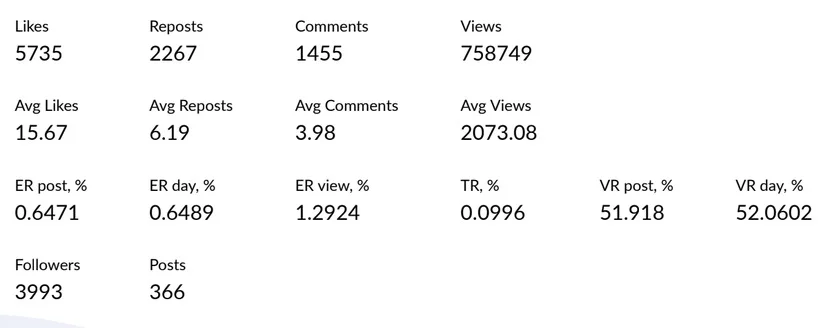
It was more than enough to get started. But my job was to organize and build on what was already there, so we could outperform our competitors through organic growth. Time to get things moving.
Gathered Insights from Across the Team
Since I was new to the project, my first step was to understand the company's products. I wanted to get up to speed quickly and develop at least some initial hypotheses to work with. So I started by talking to people across the team.
Spoiler: later on, I also conducted product research, launched surveys, and collected tons of data for analysis.
Here's who was on my interview shortlist:
Company founder. He knew the business inside out because he'd spent years building it from the ground up. I asked him about every aspect of the business, its strengths and weaknesses, and who its customers were.
Business Development Director. As it turned out, he had the deepest understanding of day-to-day operations. He explained what challenges the business faced, which processes were running smoothly, and where the biggest risks were.
Chief Technology Officer (CTO). He knew everything that went on behind the scenes. He walked me through the company's technical solutions and explained what set us apart from competitors in terms of technology.
I also sent a questionnaire to the customer support team. They were on the front line, talking to customers every day. Their answers gave me a better understanding of how they saw our customers and what they considered the company's key strengths and unique features.
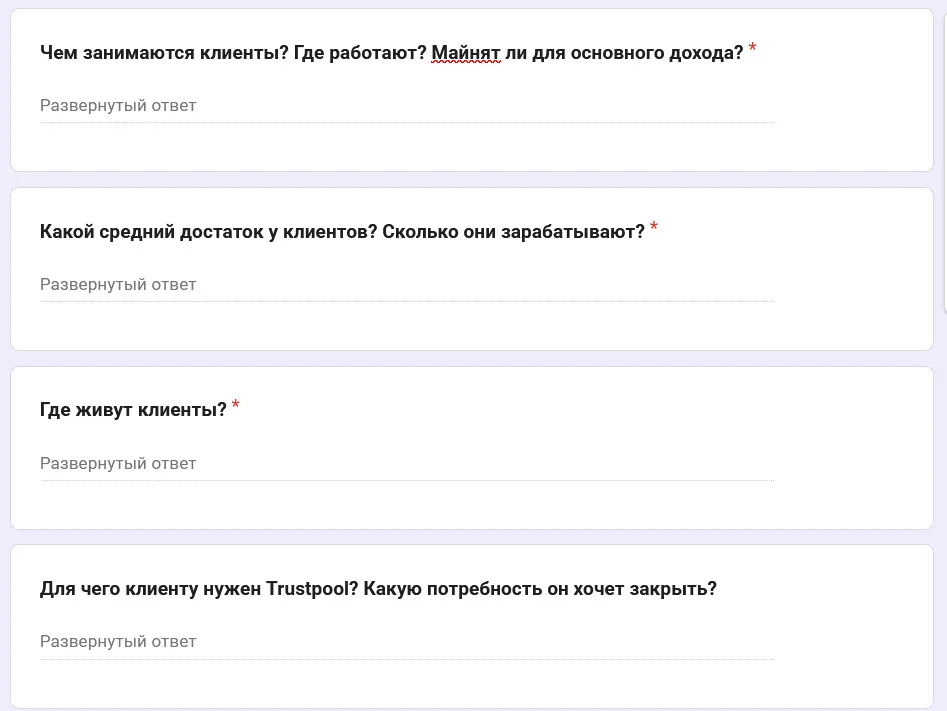
I also wanted to talk to customers directly, but I couldn't reach them at that stage. Miners tend to be very private — they don't share much about themselves and aren't keen on giving out personal information. So I had to build my first hypotheses based on what the team already knew.
Analyzed a Year's Worth of Content in Our Niche
After talking to the team, I exported our content performance data for the previous year. I sorted posts by their metrics and manually reviewed which topics and formats performed well and which ones barely got any attention. This gave me a list of our best- and worst-performing content to use as a starting point.
It turned out that our audience was much more interested in mining itself than in cryptocurrency in general. How to earn more, spend less, and set up their equipment. Miners don't necessarily have to be interested in crypto. They have machines that make them money, and that's what they want to read about.
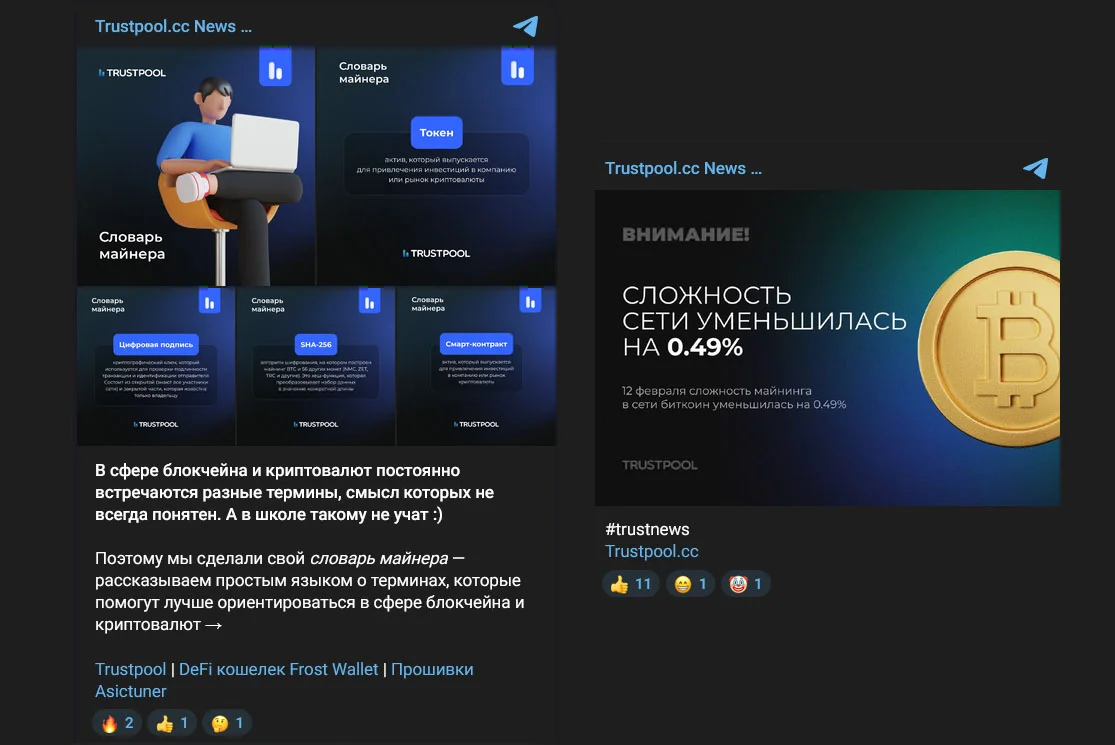
Next, I analyzed four competitors that the management and customer support team had previously identified. I looked at each company’s positioning, the promises they made on their websites, and customer reviews: what users liked about each pool, what they complained about, and how well their actual experiences matched what the companies claimed about themselves.
I went through every platform where our competitors published content: Telegram, VK, Instagram, YouTube, their website blogs, and vc.ru. Where statistics were publicly available, I collected performance data for the period from February 1, 2023, to February 1, 2024. I tracked views, average reactions, engagement per post, and daily engagement. Where the numbers weren't available, I analyzed the content itself.
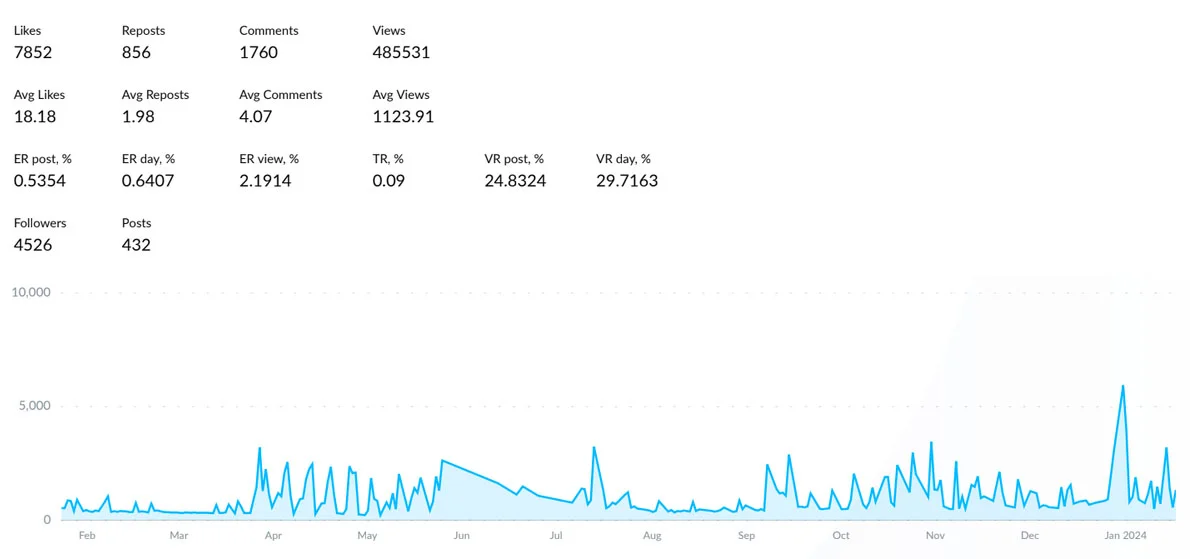
I looked at what the companies published, how often they posted, how they communicated with readers, and why anyone would want to follow them in the first place. That last part was often a problem.
Some channels were basically one long advertisement: "Look how great we are," "Check out our fees," "Join our pool now." Others were little more than technical update feeds: something broke, something got updated, something got fixed. Their blogs featured articles about New Year's gifts, exchanging currency for holidays, and the history of money. All of this was pretty far removed from what someone trying to figure out their mining setup actually needed.
There were some good ideas, too. For example, one competitor's short, casual videos got twice as many views on average as any other type of post. Others had handy hashtag navigation, news roundups, and links to related articles. I made a note of these ideas as well.
For each mining pool, I put together a summary of what we could learn from them and which mistakes we should avoid. Then I combined everything into a competitive analysis.
It became clear where we could outperform our competitors. Their channels and blogs were full of ads and news, but offered very little useful, expert-level content for miners. So I built our strategy around niche content: helping readers solve real problems and using that value to show them the benefits of Trustpool.
Analytics Helped Me Figure Out What to Write About
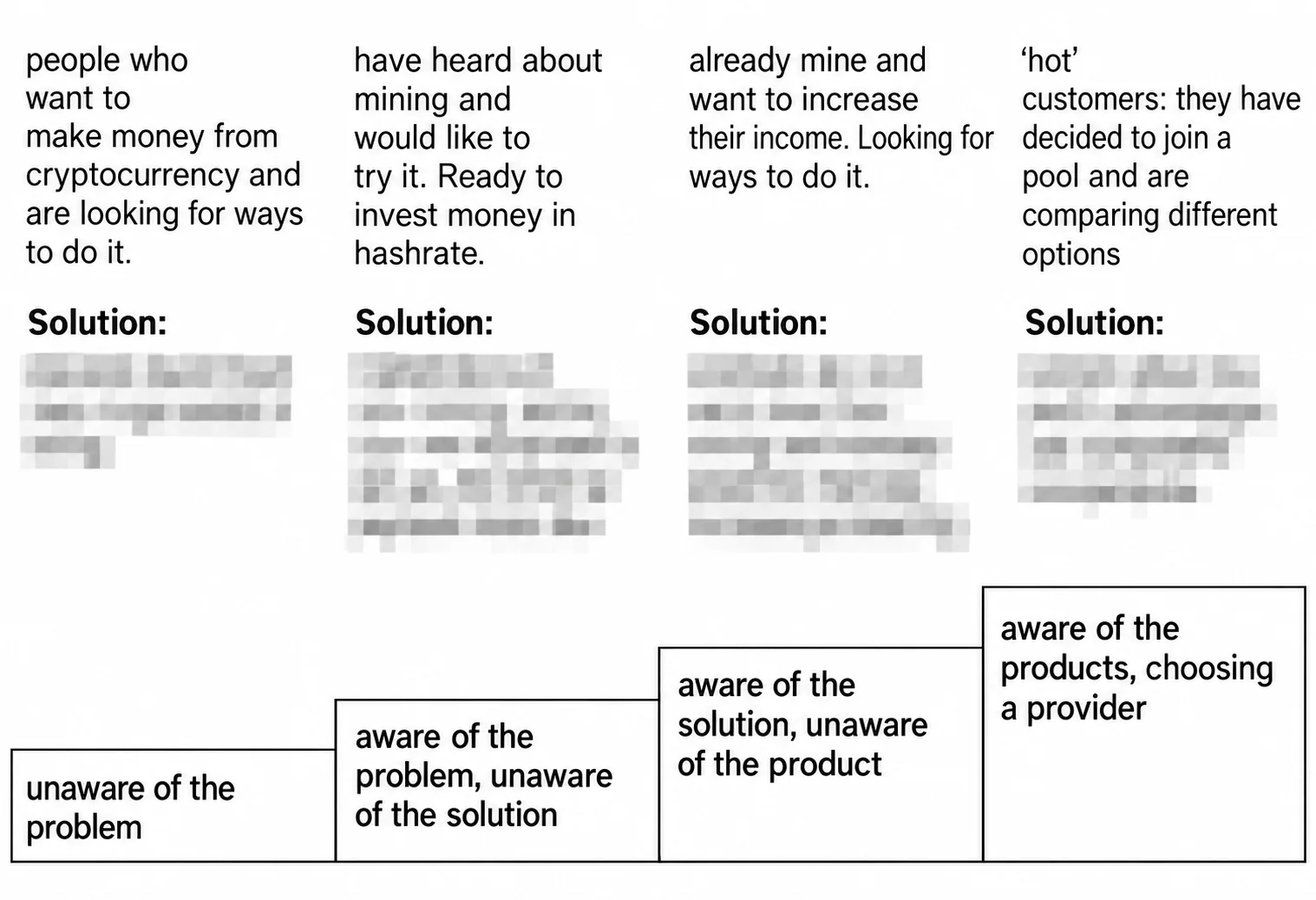
I mapped out the customer journey: how someone first learns about mining, decides to give it a try, chooses their equipment, and eventually starts looking for a mining pool. To do this, I used Ben Hunt’s Awareness Ladder, which helped me group potential customers based on how ready they were to use our product.
Our top priority was people who had already decided to start mining, bought their equipment, and were looking for a pool to connect it to. We needed to explain what our pool could offer them and why they should choose Trustpool.
We started rebuilding our content strategy around three key principles:
Provide value first, then introduce the product. Show Trustpool's benefits through content that helps people solve real problems. There are always plenty of other opportunities to tell everyone how great we are.
Focus on niche content. Stick to mining: equipment, settings, profitability, common mistakes, and other topics our readers deal with. Our own statistics had already shown that people were more interested in these topics than in general crypto news.
Make the content more fun and engaging. Our competitors communicated in a dry, neutral, or overly serious tone. I wanted our content to feel more lively and have some personality. That's one reason we made memes an official part of our content strategy and started creating them with a clear purpose.

Next, I defined three content categories and decided how to distribute posts between them:
Acquisition. Memes, short guides, and checklists — content that's easy to share with others.
Engagement. In-depth articles, explainers, and tutorials on mining and equipment setup. Content that gives people a reason to keep coming back.
Conversion. Articles about Trustpool's products and benefits that help readers decide to choose our pool.
Within each category, I came up with specific content formats: analysis, practical tips, myths and common mistakes, Q&As, simple explanations of complex topics, and interactive posts. Some were based on formats that had already performed well, while others were new ideas I wanted to test.
Another key principle was content repurposing. If the team spent time creating an in-depth article, we could turn it into several smaller posts and adapt them for different platforms. That way, a single topic could stay relevant longer and reach more people.
I also compared publishing times with post reach, using data from both our channels and our competitors. This helped me identify the best and worst times to publish. The goal was to get the most out of every piece of content by publishing it when the largest share of our audience was online.
Documented Processes So the Team Could Grow
When one person handles all the content, they can keep most of the rules in their head. But we were planning to expand into new areas and bring in more writers. So I started documenting our workflows to help newcomers get up to speed faster.
I put together a content strategy, an editorial style guide, and instructions for specific tasks. The strategy covered who we were writing for, what we wanted to achieve with our content, which formats we used, and how we measured success. It also linked to our research and more detailed guides.
I'm a bit of a neat freak when it comes to organizing things. One of the first things that drove me crazy was seeing “Bitcoin” spelled differently across our content, with “hashrate” getting a new spelling every other time. So I used the editorial style guide to establish how we communicated with readers, referred to our products, spelled technical terms, and formatted our content. I wanted articles written by different people for different platforms to feel like they all came from the same company, with a consistent and recognizable voice.
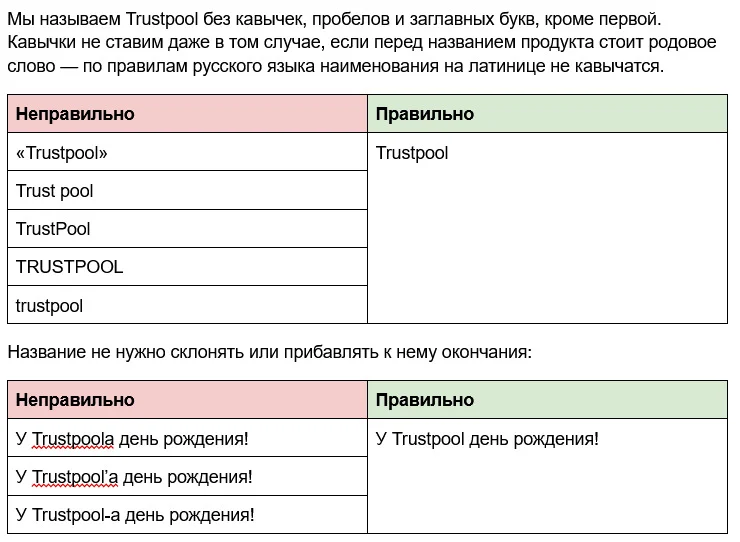
Some guides were prepared well in advance. For example, I wrote our SEO writing guide six months before we hired a writer for that role. I already knew we'd need a blog, and I wanted everyone to know how to work on it by the time we launched.
When the new writer joined, the guide was already there. According to him, he barely needed to look at it again after reading it once — everything was clear from the start. He did refer to the editorial style guide whenever he had questions about formatting or terminology.
Over time, our content knowledge stopped being something we had to explain to every new team member from scratch. Instead, we had a set of documents that helped people understand how things worked and gave them something to refer back to whenever they needed a reminder.
Started Tracking 16 Content Performance Metrics
I consider regular analytics one of the most valuable improvements I introduced. I set up a system of 16 performance indicators: 12 raw metrics and four calculated indexes based on them.
We tracked link click-through rates, reach relative to follower count, engagement per post, and daily engagement. We looked at which posts got the strongest reactions, how audience activity changed over time, and how many people clicked through to the next step. We also analyzed where we were losing users on their journey to our website and registration.
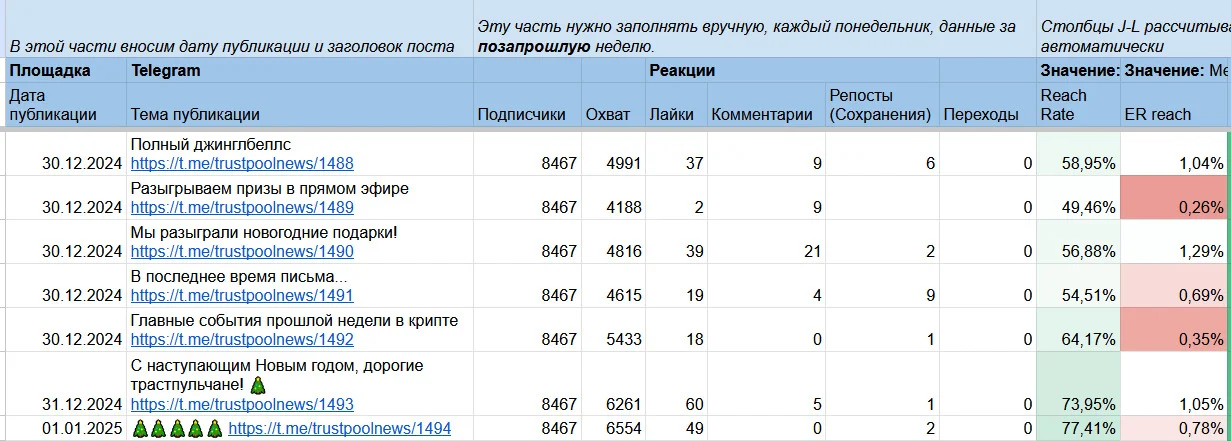
We exported the statistics every Monday, covering the week before last. And yes, the week before last, not the previous week. Here's why: if we used the previous week's data, a post published on Sunday would have been live for less than a day, while a Monday post would have had a full week to collect views. Newer posts simply wouldn't have enough time to reach their audience, making the comparison unfair. Giving them an extra week solved this problem.
We used these insights to adjust our content strategy. If a format consistently failed to engage readers, we dropped it. I'd rather protect the team's time and energy than try to save a content series nobody reads. Besides, putting in effort week after week without seeing results can be exhausting.
At the same time, we started collecting customer feedback systematically — from the support team, our community chat, and feedback forms. This gave us a steady stream of new insights into what our customers actually cared about.
Gained 3,500 Followers in a Year with Almost No Ads and Outperformed Our Competitors
The most important part of any strategy is putting it into practice. You can come up with all kinds of great ideas, but what really matters is whether they deliver measurable results. In 2024, our small team published 462 Telegram posts, 31 articles on vc.ru, and 34 articles for our SEO blog, which we also launched that year.
Our Telegram posts generated 2,182,688 views, and the channel gained 3,500 new followers. We barely spent anything on promotion through external channels, publishing no more than five paid posts throughout the year.
But I also wanted to see whether the quality of our content had improved. So I compared our performance with the previous year and with our biggest competitor.
We completely outperformed our previous results. Compared to the same period in 2023, all four performance indexes increased by at least 2.2 times.
Metric | Before | After | Growth |
|---|---|---|---|
Engagement rate per post (ERp) | 0,2315% | 0,5924% | ×2,6 |
Daily engagement rate (ERd) | 0,1375% | 0,7581% | ×5,5 |
VRp | 25,4601% | 56,1297% | ×2,2 |
VRd | 15,1153% | 71,8335% | ×4,8 |
Daily engagement saw the biggest increase, growing 5.5 times. Engagement per post also improved, meaning individual posts were getting more reactions relative to our follower count.
We outperformed our closest competitor. Compared to our main competitor, the one we'd been using as a benchmark, our performance metrics were 1.4–3.1 times higher.
Metric | Trustpool | Competitor | Difference |
|---|---|---|---|
Engagement rate per post (ERp) | 0.5924% | 0.3889% | 1.5× |
Daily engagement rate (ERd) | 0.7581% | 0.5322% | 1.4× |
VRp | 56.1297% | 17.9144% | 3.1× |
VRd | 71.8335% | 24.5145% | 2.9× |
When I first joined the project, I saw an opportunity to outperform our competitors by creating useful, niche content and finding the right balance between attracting new audiences and keeping potential customers engaged. Once we put this approach into practice, it delivered real results without the need for huge marketing budgets.